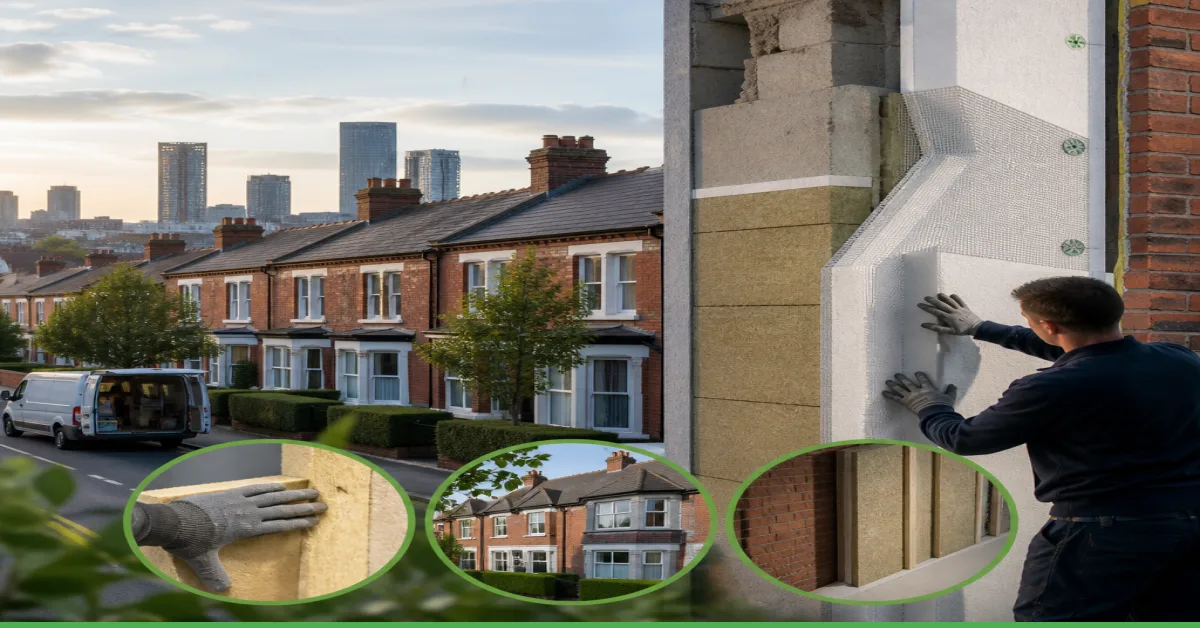
Solid Wall Insulation Manchester
Get a tailored solid wall insulation service for your Manchester home. Expert survey, internal/external options, planning advice, and grants. Local specialists.
Why Manchester’s Solid-Wall Homes Need Special Insulation
Manchester’s Victorian and Edwardian terraces, 1930s semis and many council-built homes have solid walls with no cavity to fill, so they lose heat faster than cavity-wall houses and need purpose-designed internal or external insulation rather than a standard cavity fill. Around 40% of a solid-wall home’s heat is lost through the fabric, so the wall build-up is usually the single biggest improvement available.
These are the solid-wall types we survey most often:
Victorian & Edwardian Terraces
Red-brick terraces in areas such as M14 and M19, often with lime or mixed mortar and original brick facades. These homes typically sit on shallow footings and were built to breathe, so moisture management is central to any insulation spec.
1930s Semis
Solid brick or early blockwork, bay windows and cold bridges at floors and party walls. Many have damp-proof courses installed in the 1960s or 1970s that are now failing, which makes the moisture survey critical.
Council-Built & Interwar
Solid-wall houses in M40 and similar postcodes, where later alterations can hide damp and cold spots. Rendered or pebble-dashed facades on these homes often make external insulation the most practical option.
The Heat Loss Reality
An uninsulated solid brick wall typically has a U-value around 2.0 W/m²K, while a filled modern cavity wall can sit nearer 0.3 W/m²K. That gap shows up as cold rooms, high gas use and condensation on external walls during Manchester winters.
Manchester’s humid, wet climate changes the specification. Persistent rainfall and indoor moisture raise the risk of interstitial condensation if insulation traps damp in the brick. Breathable build-ups, vapour control where it is needed, and a moisture survey come before product choice, not after. A wall that looks dry in June can still be holding significant moisture from a wet spring, which is why we time surveys carefully and always take readings at multiple depths.
Internal vs. External Insulation for Manchester Homes
Internal wall insulation lines the inside face of the solid wall and keeps the brick outside unchanged, while external wall insulation wraps the outside in insulation and a new finish, which usually saves more heat but alters the facade and can trigger planning checks in conservation streets.
| Decision Point | Internal Insulation | External Insulation |
|---|---|---|
| Space and Disruption | Reduces room size by roughly 80–100mm when you include the insulation board and finish, which can be significant in a 3.5m terrace bedroom. Rooms are taken out of use in phases. Skirting, sockets, radiators and kitchens need making good. | Keeps internal floor area. Scaffolding, access and weather windows drive the programme. Occupied homes stay usable inside if services are planned. You do need a dry spell for the render work, which narrows installation windows in Manchester. |
| Planning and Appearance | Usually no planning permission on unlisted homes, because the work is internal. Original red brick on the street stays visible. You do need to check party wall rules for attached terraces. | Often needs permission in conservation areas, including parts of M14, M19 and Stockport. Changes eaves, cills, rainwater goods and the brick face. A brick-effect finish can help but never fully matches original brick. |
| Best Local Fit | Listed buildings, strict conservation facades, and terraces where the red-brick front must stay. Also works well for homeowners who cannot get scaffolding access to the rear. | Homes where the facade can take a new finish, including many 1930s semis and later council houses outside protected streetscapes. Also good where internal space is too tight to lose. |
| Manchester Moisture Note | Needs a vapour control layer and careful detailing at windows, floors and party walls so indoor humidity does not condense in the brick. Lime-based vapour-permeable systems suit pre-1900 homes better than sealed board systems. | Needs sound, dry masonry first. Older terraces often need repointing before boards go on, or the new system sits on a weak, wet wall. The external render must be vapour-permeable to let residual moisture escape. |
Choose External Insulation When:
You can change the outside and want the wall fabric kept warmer. External systems generally perform better at blocking rain ingress and eliminating thermal bridges, but they only work where the facade can change.
Choose Internal Insulation When:
Planning, listing or a red-brick street front rules out a wrap. Use this when you need to preserve the original facade and keep disruption inside the property.
⚠️ Manchester Condensation Warning
Condensation is the main specification risk in Greater Manchester’s humid climate. Internal systems without vapour control can push moisture into cold brick and show as damp patches later. External systems fail when cracked, unpointed mortar is covered rather than repaired. We survey moisture and mortar before either method is quoted.
Costs and Grants for Manchester Homeowners
External solid-wall insulation on a Manchester terrace commonly sits in the £7k to £16k range, with semi-detached homes usually costing more because of extra wall area, more detailing and a larger scaffold.
External Insulation — Terrace
£7k – £16k
Driven by wall area, window reveals, rainwater goods, render type and any repointing. A conservation-approved finish can push the upper end of the range.
External Insulation — Semi
£10k – £20k
Usually above the terrace range for the same system, because of gables, bays and more linear metres of finish. Expect more depending on storey height and render complexity.
Internal Insulation
Often a lower materials and scaffold cost, with more spend on joinery, electrics, kitchens and making good each room. A typical 3-bed terrace rooms cost roughly the same as external for the whole house, but you lose floor space.
Add-Ons That Move the Quote
Moisture treatment, mortar repair on pre-1900 brick, conservation finishes, and working in occupied homes while rooms are in use. Access in tight terraces and parking also affect the final figure.
💡 Savings Reality Check
A 2023 survey of Manchester energy prices suggests a typical terrace could save in the region of £300–£500 per year depending on occupancy and existing heating system.
Funding Routes
| Funding Route | Who Should Check It | What to Confirm |
|---|---|---|
| National Schemes (ECO, GBIS) | Lower-income households, qualifying benefits, and some poorly rated solid-wall homes | Eligibility rules change. The Green Homes Grant has closed. ECO4 is the main active route but is tightly means-tested. |
| Council Programmes | Owner-occupiers and some landlords in Manchester City Council and neighbouring authority areas | Local top-up or area schemes can apply. Some Greater Manchester boroughs fund solid-wall measures through LAD. Ask the surveyor to flag live routes. |
| Stockport Conservation Support | Homes in Stockport conservation areas that still need energy upgrades | These streets often qualify for extra local or heritage-linked help. Conservation officers sometimes grant permitted development relaxations for discreet schemes. |
⚠️ Grant Warning
Grants never replace a moisture-safe specification. A funded system that traps damp in a Victorian terrace is still the wrong buy. Some ECO-funded internal insulation installations in pre-1900 homes have used non-breathable boards that later created interstitial condensation, so insist on a fabric-appropriate build-up even when the grant dictates the installer.
Manchester’s Planning and Permission Rules
External insulation on a Manchester solid-wall home often needs planning permission in conservation areas and always needs listed-building consent where the house is listed, while internal insulation on many unlisted homes, including some Salford postcodes, can proceed without a planning application.
🏛️ Conservation Areas (M14, M19, Stockport)
External wraps, new renders and changes to brick, eaves and windows are high-risk for refusal if they erase the street character. Many Manchester conservation areas have Article 4 directions that remove permitted development rights. Internal insulation is usually the planning-safer route on protected red-brick fronts.
📜 Listed Buildings
Internal and external insulation both need listed-building consent. Breathable, reversible details matter more than maximum thickness. Manchester’s conservation officers typically prefer lime-based internal systems that can be removed without damaging historic fabric.
🏙️ Manchester City Council
Some external energy upgrades can use a faster approval route than a full redesign. The council has moved toward a more supportive stance on fabric energy measures where the design preserves street character. We check the current process for your ward.
🏘️ Salford Internal Works
Internal insulation on many Salford unlisted homes does not need planning permission because the work stays inside. External insulation, article 4 directions and listed fabric still need a proper check. Salford’s boundary with Manchester means some streets fall under different rules.
📐 Party Walls & Neighbours
Terrace work can engage the Party Wall etc. Act 1996 even when planning is not required. External insulation that increases wall thickness by 100mm can affect your neighbour’s rainwater goods, eaves and boundary line. A party wall notice is required where the work sits on or near the boundary.
⚠️ Don't Skip the Planning Check
Do not order boards until the planning position is clear. A survey that records facade type, listing status and conservation boundary prevents a rejected external scheme and a wasted scaffold quote. A common error is assuming that because internal work rarely needs permission, external work will also be exempt — a refusal stays on the planning record for your property.
How Manchester Wall Insulation Surveys Your Home
Manchester Wall Insulation surveys a solid-wall home by mapping moisture, checking mortar and cold bridges, then specifying internal or external insulation that the wall can actually carry, with condensation checks and a 10-year guarantee after installation.
Brief & Access
You tell us the property type, postcode and whether rooms must stay in use. We plan a survey that works in occupied terraces and semis. If scaffolding can only reach the rear of a terrace, that changes which method is physically installable.
Moisture Mapping
We measure damp in walls and floors, with extra attention in damp-prone stock around Oldham and M40. We use pin-type moisture meters and take readings at multiple heights, including the base of walls where rising damp commonly appears.
Thermal Imaging
We use thermal images to find cold bridges in red-brick terraces, around bays, lintels, party walls and floor edges that a visual look misses. These images also reveal where wall ties have failed or insulation has already been added badly.
Mortar & Fabric Check
On pre-1900 homes we survey mortar condition before any external system is proposed. Weak, washed-out or cement-over-lime joints need repair first. We also inspect the base course, where Manchester’s clay subsoil can bridge the damp-proof course.
Specification & Quote
You get a written choice between internal and external methods, planning notes for your street, and a programme that covers disruption, scaffold and making good. The quote itemises moisture work, mortar repair and any conservation finishes so you can see exactly what you are paying for.
Install & Aftercare
We install to the agreed specification, then carry out condensation checks. Cover includes a 10-year guarantee on the installed system. A post-installation thermal image check verifies that cold bridges have genuinely been eliminated.
🏠 Typical M19 Terrace Survey
A Victorian red-brick front in a conservation street often shows cold spots at the front wall and wet mortar at the lower courses. The practical outcome is usually internal insulation with vapour control on the protected elevation, or external insulation only where the rear or a later extension can take a new finish, after repointing. The front wall stays the hardest decision because changing it risks planning refusal and losing street character.
A Manchester-based survey matters because the same product fails for different reasons in M14 brick, 1930s semis and M40 council stock. Pre-1900 homes need breathable systems, 1930s semis need careful DPC checks, and post-war council homes often have existing damp issues that trace back to earlier poor alterations. We specify for the wall in front of us, not a generic solid-wall diagram.
Book a survey when you want a method, a moisture plan and a quotation you can take to planning or funding, not a product leaflet. Start at manchesterwallinsulation.co.uk.
Risks and Fixes for Manchester Properties
The main post-installation risks on Manchester solid-wall homes are trapped damp, cracked external finishes and poorly specified ground-floor details, and each has a practical fix if the survey catches it early.
Damp Patches in 1930s Semis
Internal boards on cold, slightly wet masonry can show staining. Many 1930s semis have solid floors that sit directly on clay, which changes the moisture dynamic at the wall base.
Fix: Confirm the wall is dry enough, then use a breathable membrane and the right vapour control, not a sealed plastic layer on a wall that still needs to dry.
Cracking Render on External Insulation
Rigid finishes on older, slightly moving terraces crack at corners and reveals. Manchester’s freeze-thaw cycles in late winter accelerate cracking in poorly detailed systems.
Fix: Flexible finishes, proper movement joints and sound substrate, including repointing before the wrap.
Ground-Floor Damp on Clay
Manchester’s clay soils hold water against lower walls, so ground-floor insulation can worsen rising or penetrating damp if the plinth and floor edge are ignored.
Fix: Survey the DPC line, external ground levels and floor junction before insulating the lowest metre. Ground level must sit at least 150mm below the DPC.
Cowboy Specifications
Some contractors offer board thickness quotes without moisture readings or mortar notes. A contractor who has never worked in a conservation area will not know the detail standard required.
Fix: Ask for conservation-area references, moisture readings and mortar notes. Check they have actually dealt with a listed-building application or an Article 4 direction.
Rainwater Goods Failure
Blocked or leaking gutters on Manchester’s older roofs saturate the top of solid walls, which shows up days or weeks after an external insulation install.
Fix: Inspect, repair or reroute gutters before any wrapping begins.
✅ The Bottom Line
Appoint the contractor who can explain the risk for your wall type and write the fix into the quote. If they skip moisture mapping or mortar checks on a pre-1900 terrace, do not proceed. The cheapest quote is usually the one that omits the preparation work your wall actually needs.
Frequently Asked Questions
What’s the best insulation for a Victorian terrace in Manchester?
The best insulation for a Manchester Victorian terrace is the method that keeps the wall dry and respects the facade: internal insulation with vapour control on protected red-brick fronts, and external insulation where the elevation can change and the mortar is sound enough to take a wrap. A breathable, lime-compatible internal system is usually the safest starting point because it avoids planning risk and lets the brick keep drying.
Does internal insulation cause damp in Manchester’s climate?
Internal insulation can cause damp in Manchester if it traps indoor moisture in cold, humid brick without a vapour control layer and without a moisture survey. Specified correctly, with dry walls and sealed junctions at windows and floors, it does not have to create damp. The key is specifying a vapour-open system that lets residual moisture escape rather than a sealed barrier that traps it.
How long does external insulation last in Manchester?
External wall insulation typically lasts 25 years or more in Manchester when the render, flashings and rainwater goods are maintained and the masonry was dry and well pointed at install. Unrepaired cracks and blocked gutters shorten that life in this rainfall climate. Regular repainting of the render and checking movement joints every five years keeps the system performing.
Can I get insulation grants if I live in a Stockport conservation area?
Yes, you can still seek insulation grants in a Stockport conservation area, and those homes often qualify for extra local or heritage-linked support on top of national schemes. Conservation status can restrict external finishes, so confirm both funding and planning before you choose a system. Ask your surveyor to flag any heritage funding routes that apply to your street.
Will insulation change the look of my red-brick home?
External insulation will change the look of a red-brick home unless a brick-effect or similarly approved finish is allowed, while internal insulation leaves the outside brick as it is and only alters the inside face of the wall. On a conservation street, the brick face is usually the deciding factor — if the front must stay original, only internal insulation is realistic.
Do I need planning permission for insulation in Salford?
You usually do not need planning permission for internal insulation on an unlisted Salford home, but you often do need it for external insulation, and you always need the right consents on listed buildings or where a direction restricts the facade. Check whether your street has an Article 4 direction before assuming external work is exempt.
Next Step
Request a solid-wall survey from Manchester Wall Insulation if you own a terrace, 1930s semi or council-built house and want a moisture-checked specification, a clear quote and help with planning or grant questions for your postcode.
Arrange a survey with Manchester Wall Insulation →Ready for a Warmer Manchester Home?
Book a free survey. We will tell you which system fits your walls, what it costs, and whether a grant applies to your postcode.
Warmer Homes. Lower Bills. Greener Manchester.