1. Survey
Around half a day on site. Wall build-up, damp, ventilation, sockets, and access are checked. Red-brick homes need moisture readings before boards are specified. If walls are wet, insulation waits until the cause is understood.
Manchester & Greater Manchester
See 2026 internal wall insulation costs in Manchester: £50-£80 per m², typical terrace £3,500-£7,000. Get a measured survey for your home.
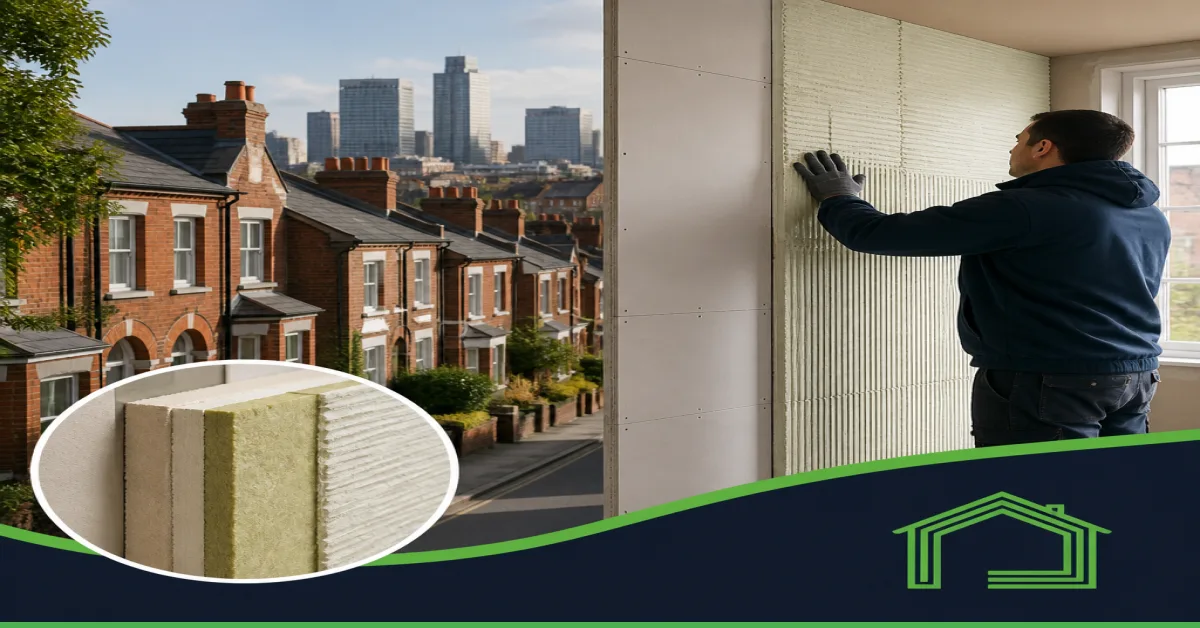
Manchester internal wall insulation costs £50-£80 per m² in 2026, including plastering, with a typical 2-bed terrace landing between £3,500 and £7,000. Those figures are installer-style averages for internal wall insulation on local homes, not a catalogue price, because wall area, board thickness, and making-good decide the total.
Use the table to test whether a whole-house budget is realistic, then treat per-room quotes as the way to phase work if you cannot do every elevation at once.
| Property type | Typical insulated wall area | 2026 total (inc. plastering) |
|---|---|---|
| 2-bed terrace | 50-90 m² | £3,500-£7,000 |
| 3-bed semi-detached | 80-120 m² | £6,000-£9,500 |
| Detached | 110-160 m² | £8,000-£13,000 |
A 4m x 5m living room in Manchester usually costs £1,200-£2,500 once returns, plaster, and fittings are included. Mid-terrace rooms with one cold wall sit toward the lower end. Corner rooms and bays sit higher because more external wall is treated. A typical 3.5m x 3.5m bedroom with one external wall is often cheaper than the living-room figure because there are fewer reveals, sockets, and radiators to move.
Tip: Window reveals add 15-25% to room costs in Manchester’s period homes. Reveals, linings, and making good around original windows are a large share of labour on Victorian and Edwardian stock, so a quote that prices only the flat wall will understate the job.
Older homes with uneven walls often need about 20% extra. That uplift is common in red-brick areas such as Chorlton, where out-of-true masonry, blown plaster, and packing behind boards add time before insulation can sit flat. National per-m² headlines usually assume straight, dry plaster. Manchester period walls rarely are.
Board type also moves the rate inside the £50-£80 band. PIR is often the lower material cost. Phenolic boards usually cost more per m² but can be thinner for the same U-value, which matters in small terraces where floor area is tight. Ask the quote to name the board, thickness, and target U-value, not only a blended m² rate.
Extra costs typical Manchester installer quotes separate unless the survey lists them
Ask for a measured survey from Manchester Wall Insulation if you need a figure you can brief against. Live quotes follow the walls, access, and moisture findings in your house, not a per-m² headline alone.
Internal wall insulation is typically 30-50% cheaper than external wall insulation in Manchester, for example around £7,000 against £12,000 for a semi-detached house. Cost is only the first filter. Access, planning, room size, and moisture control decide which system fits the house.
Internal work stays inside the building line, so terraces with no scaffoldable frontage or shared walls often have no practical external option. External work keeps rooms full size, but it changes the elevation and often needs planning permission, which is a real hurdle on many Manchester streets.
Do not treat cavity-wall fill as the cheaper alternative on a 1930s red-brick terrace. Most of that stock is solid wall. Cavity insulation only applies where there is a clear, dry cavity. For solid walls the real choice is internal lining versus external cladding.
| Factor | Internal wall insulation | External wall insulation |
|---|---|---|
| Typical Manchester cost | About 30-50% lower (semi example around £7,000) | Higher, with scaffolding and finish (semi example around £12,000) |
| Space | Loses several centimetres per insulated wall, often 50-100mm with board and plaster | No internal floor-area loss |
| Planning | Not usually needed on unlisted houses | Often needs permission because the outside face changes |
| Access | Works where there is no external access, including mid-terraces | Needs clear elevations and scaffold space |
| Moisture on red brick | Needs a vapour control layer and careful detailing | Keeps the existing wall warmer from the outside |
| Disruption | Inside rooms, furniture, and decorations | Outside, weather-dependent, less room-by-room upheaval |
| Home type | Best for | Manchester reason |
|---|---|---|
| Terraces | Internal | Party walls and tight streets limit external access |
| Listed buildings | Internal (with consent checks) | Outside appearance stays put; internal fabric may still need listed building consent |
| Detached homes | External, if budget and planning allow | All elevations can be reached and rooms keep their size |
| Post-1990s homes | Confirm the wall build-up first | Many have cavities; internal boards are for solid walls or failed cavities, not a default |
Choose internal insulation if you need a lower capital cost, cannot scaffold the street elevation, or must protect the outside look of the house. Choose external if you can get permission, have access, and will not accept lost floor area.
Local expert tip: Manchester’s humid winters raise condensation risk on cold red-brick internal faces. Internal insulation only performs if the survey sets vapour control, ventilation, and drying time. Skipping that detailing to save a day on site is how mould appears behind new plaster.
ECO4 grants can cover 30-100% of internal wall insulation costs for eligible Manchester households, especially EPC band D-G homes in postcodes such as M14 and M15. Those postcodes are examples, not a closed list. Coverage depends on the property, the household, and the scheme rules at the time of application, so treat any online “fully funded” claim as a possibility to check, not a promise. We do not quote a fixed grant amount because ECO4 awards vary by household.
Red-brick solid-wall homes in Manchester often qualify on construction grounds because they are hard to treat compared with standard cavities. Income, benefits, and EPC evidence still have to line up. A low EPC alone does not unlock funding. Greater Manchester Energy Advice is the place to check current income thresholds and local scheme routes before you budget as if a grant is certain.
3 questions to check ECO4 eligibility
If you answer yes to the first two and are unsure on the third, do not guess the funding. Confirm household eligibility, then book a technical survey so the wall specification matches what a funded or part-funded job would need.
How to apply
We will tell you at survey whether the house is a realistic internal insulation candidate. We will not invent a grant figure. If ECO4 or another route may apply, the quote should still show the full works cost so you can still proceed if funding is partial or refused.
Internal wall insulation on a Manchester semi-detached home typically takes 2-4 weeks from start on site to plastered finish. Terraces with fewer external walls can be quicker. Detached houses and full-house phasing take longer because more rooms have to be cleared and finished. Damp winter weather can stretch that programme if plaster is asked to dry in cold, unventilated rooms.
Manchester Wall Insulation runs the job as a sequence: enquiry, survey and moisture checks, written specification and quote, programme agreed around occupied rooms, installation, plastering, then handover. You should know which rooms are out of use on which days before the first board is cut.
Around half a day on site. Wall build-up, damp, ventilation, sockets, and access are checked. Red-brick homes need moisture readings before boards are specified. If walls are wet, insulation waits until the cause is understood.
Costs are tied to measured walls plus extras. Room order is set so you can still live in the house.
Skirting, fittings, and failed plaster come off the walls being treated.
Insulation is fixed, services are brought forward, and walls are plastered.
You get a clear point when decoration can start.
Room-by-room disruption is the part national brochures skip. A kitchen can be unusable for 48 hours while wall units, splashbacks, or services on an external wall are moved and the lining goes on. Living rooms are usually habitable again the same evening if furniture is stacked off the treated wall, but dust and access remain until plastering is finished.
Manchester’s damp winters slow plaster drying. Budget dehumidifiers and heating, not just calendar days. Wait 2 weeks for plaster to cure before decorating, longer if the house is cold and poorly ventilated. Painting too early traps moisture against a vapour-controlled lining.
Prep checklist before we arrive
5 questions to ask your Manchester installer
If an installer cannot answer those five points in writing, the quote is not ready to accept. We build those answers into the survey so disruption and drying are planned, not discovered on day two.
A Manchester specialist is the right appointment for internal wall insulation when the house is red-brick solid wall, because local installers already work to the ventilation, moisture, and retrofit U-value issues that generic national crews treat as extras. Manchester Wall Insulation prices and installs that work in the same housing stock you live in, not a notional cavity-wall average.
Local advantages we use on site
Including uneven walls, lime or mixed plaster, and the packing needed before boards sit true.
Designed for humid interiors, not board-only quotes that ignore condensation.
Specifications aimed at retrofit targets, so the lining thickness is chosen for performance and space loss together.
48-hour survey slots in Greater Manchester where the diary allows.
On terraces and 1930s houses, including typical Didsbury terrace layouts with narrow halls and small front rooms.
Including Victorian school and church buildings, where access, breathability, and appearance constraints are stricter than a new-build spec.
National chains often price a flat m² rate and discover Manchester street access, party-wall limits, and winter drying on the first morning. A local specialist prices those conditions at survey, then keeps one team accountable from moisture readings through plaster cure.
Choose us if you want a contractor who will walk the actual walls, tell you whether internal insulation is the right system, and give a programme you can live with. Choose a different route if you already have a full external scheme with planning in place and no need for internal linings.
Internal wall insulation in Manchester costs £50-£80 per m² in 2026 including plastering, or about £1,200-£2,500 for a 4m x 5m living room. A 2-bed terrace commonly totals £3,500-£7,000, with older uneven walls and window reveals pushing the figure up. Book a measured survey for a house-specific quote.
Cavity wall insulation is worth it in the UK where the wall has a clear, dry cavity and the fill is specified for the exposure of the house. It is not the right product for most Manchester red-brick solid-wall terraces, which have no cavity to fill. Those homes need internal or external solid-wall insulation, chosen for access, cost, and moisture risk.
The most affordable way to insulate internal walls in Manchester is to use ECO4 or related funding where you qualify, then insulate the coldest external walls first rather than every room in one go. Phenolic boards can cost more per m² than thicker PIR but lose less room space for the same U-value, which matters in small terraces. A survey should compare full-house, room-by-room, and grant-assisted options on the same drawing.
Cavity wall insulation after 25 years can slump, hold moisture, or leave cold patches if it was poorly installed or the wall has since suffered damp. In a humid climate that ageing is hard to see until cold spots and mould appear. That is one reason cavity fill is the wrong brief for Manchester solid-wall housing. Internal insulation uses boards you can inspect from inside, with vapour control designed at survey, so performance is not hidden in a sealed cavity.
You do not need planning permission for internal wall insulation on most unlisted Manchester houses. Listed buildings, and some interiors in conservation areas, can need listed building consent if historic fabric, panelling, or features are affected. External insulation is the system that more often needs planning permission because it changes the street elevation. Confirm status on your address before you strip walls.
Manchester Wall Insulation will survey your walls, check moisture on red brick, and issue a written internal wall insulation quote with room order, extras, and drying time included. That is the practical next step if you have a terrace, semi, or detached house in Manchester and need a 2026 cost you can act on.
Tell us the property type, which rooms feel cold, and whether you want a whole-house figure or a first-room phase. We will confirm whether internal insulation is suitable, how it compares with an external option for your access, and whether an ECO4 conversation is worth starting alongside Greater Manchester Energy Advice.
Start from manchesterwallinsulation.co.uk to request a site survey. Bring your EPC if you have one, and note any listed or conservation constraints. You will leave the survey with a clear scope, a programme that fits an occupied home, and a cost tied to the walls we measured, not a national average.
Book a free survey. We will tell you which internal insulation system fits your walls, what it costs, and whether a grant applies.
Get a Free Quote